Filling Out the At-Risk Building Detection Form
Filling out the Masonry Building Evaluation Form in Version 4
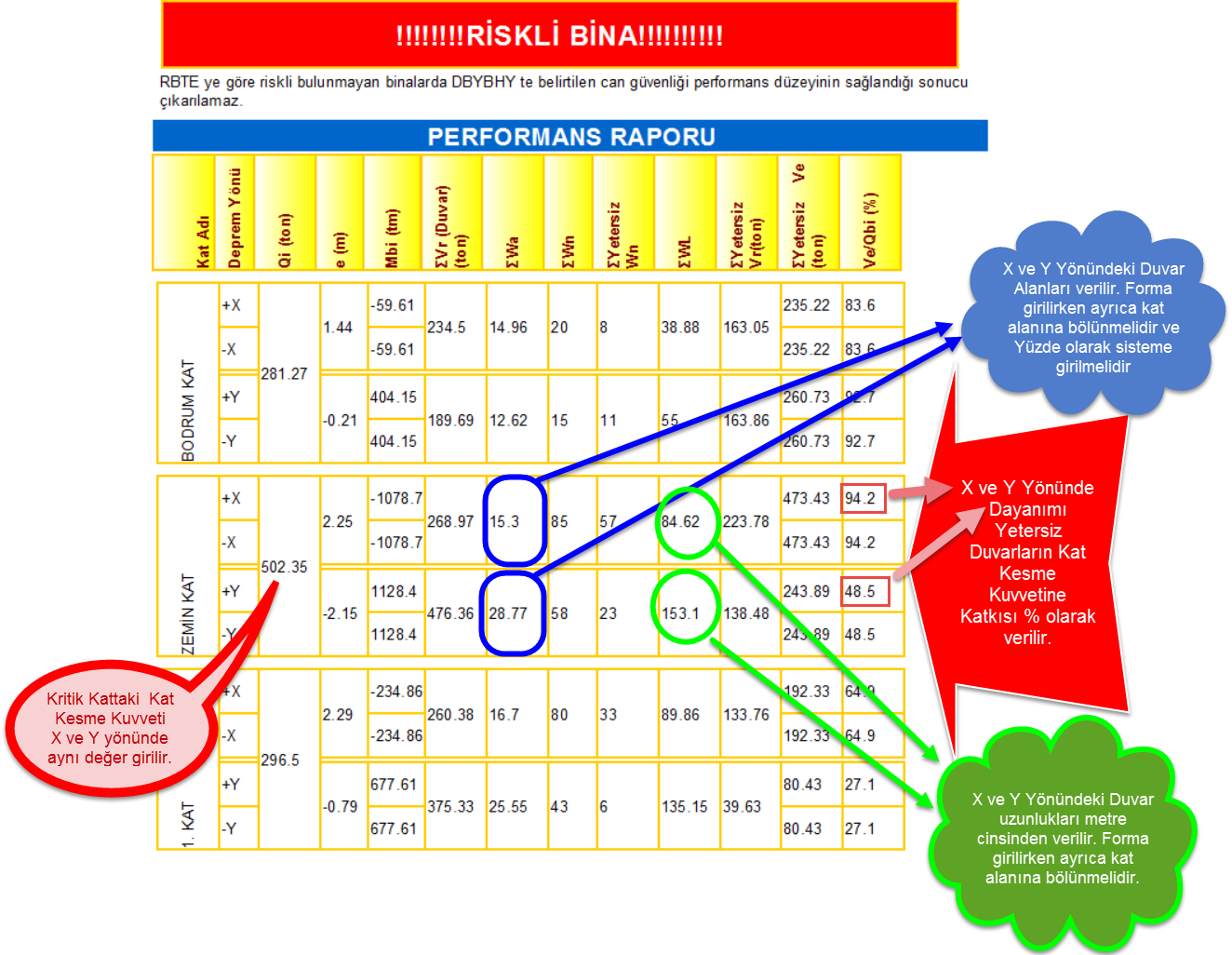
Since the sample building above has a half-basement, the basement storey seismic forces are lower than those of the ground floor.
If the Ve/Qbi value (contribution of walls with insufficient shear capacity to the storey shear force) exceeds 50% in any direction on any storey of the building, the building is declared at-risk.
If the ground floor (critical storey) is not found to be at-risk but one of the other storeys is, the building is still considered at-risk. In this case, the ground-floor values (e.g. X=20%, Y=0%) are entered into the system and the building is marked as at-risk. In the remarks section, the name of the at-risk storey is also stated in the explanation. (For example: "The building is at-risk because the contribution of walls with insufficient shear capacity to the storey shear force in the X direction is 62% on the 2nd storey.") In masonry buildings, floor plans and wall materials may vary from storey to storey, so the lower storey does not always turn out to be the most at-risk. Since the shear capacity of walls depends on the vertical load acting on them, and vertical loads increase toward the lower storeys, the shear capacity of lower-storey walls is higher. The shear load acting on lower-storey walls is also greater than that on upper storeys. These two conditions — demand and capacity — compete with each other, and in some cases (especially in seismic zones 3 and 4) the upper storeys may prove more at-risk.
A Ve/Qbi value of zero indicates that all walls in the relevant direction on that storey are resistant to seismic forces.
A Ve/Qbi value of 100% indicates that the shear capacity of all walls in the relevant direction on that storey has been exceeded (i.e., all walls are seismically inadequate).
For an explanation of the analysis differences between Version 3 and Version 4, you can access the relevant information through the links below.
VERSION 4 DIFFERENCES IN STOREY TORSIONAL MOMENT CALCULATION
Explanation of the Difference in Performance Results Between Versions
Version 3
