Slab Finite Element Mesh Option
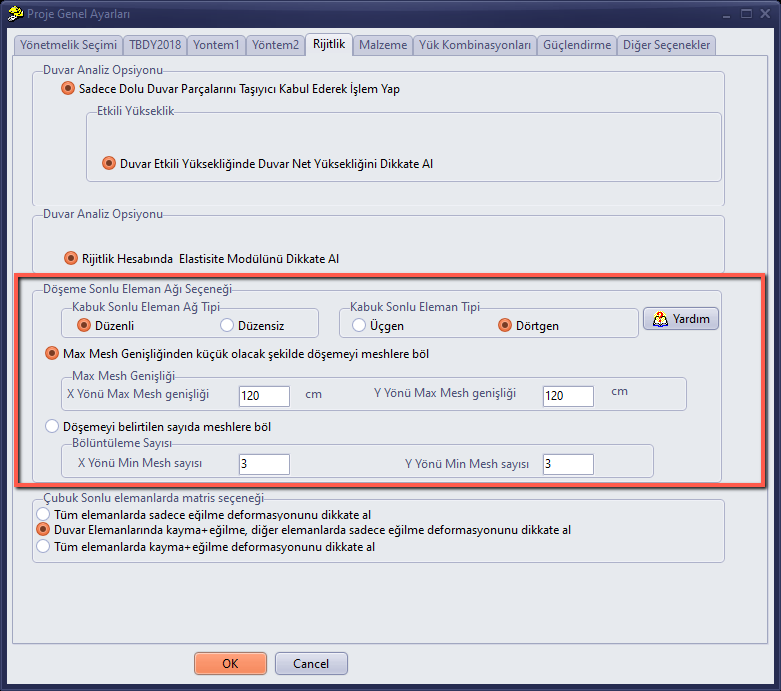
When the finite element method is selected as the analysis method in the program, slabs can be included in the system stiffness as shell finite elements and load transfer from slabs to walls can be performed via shell finite elements.
The descriptions of the options related to this topic are presented here.
User-defined options are provided to achieve an optimum level of finite element precision.
The shell finite element type can be selected as quadrilateral or triangular. The quadrilateral finite element type is a more advanced element type that yields more realistic results and is recommended for preferential use.
With the regular mesh generation option, slabs are divided into parts at specified intervals or in specified numbers. The divided parts are regular. During meshing, walls or columns resting on the slab are not taken into account; the slab is divided systematically into parts. When this method is selected, the slab must be entered separately for each room. At the top elevations of walls on the floor, the slab is not divided by the nodes of walls and beams. However, walls and beams are automatically divided by the slab nodes. Regular mesh should be used in buildings that contain inclined slabs or slabs not at the floor elevation.
With the irregular mesh generation option, slabs are divided into parts at specified intervals or in specified numbers. Then all nodes at the floor elevation are triangulated — that is, each node becomes a corner of a triangle and non-intersecting triangles are formed. In this way, full nodal contact between the slab and vertical and horizontal structural members is ensured as much as possible. If the shell finite element type is set to triangular, the analysis is performed over the generated triangular shell finite elements. If the finite element type is set to quadrilateral, neighboring triangles are identified for each triangle in the irregular triangular mesh and, where appropriate, neighboring triangles are merged to form quadrilateral shell finite elements. Those deemed unsuitable remain as triangles. The analysis is performed with some shell elements being triangular and most being quadrilateral. When quadrilateral shell finite elements and the irregular mesh option are used together, the probability of a solution error occurring in the analysis is somewhat higher. If an error occurs in the analysis, the program attempts to indicate this in the analysis window. Errors that may occur include all values being zero or infinite, or partial errors. When using irregular mesh, using triangular finite elements reduces the likelihood of a solution failure. Irregular mesh should not be used for buildings containing inclined slabs or slabs not at the floor elevation.
The generated mesh structures can be examined in 3D views.
The option "Divide the slab into meshes smaller than the Max Mesh Width" divides the slab by the length specified in the X and Y directions.
The option "Divide the slab into a specified number of meshes" divides each slab into the specified number of meshes in the X and Y directions.